Sound Safari
A screening is not a diagnosis. It answers exactly one question: is there a speech-sound concern worth a closer look? Not “what is the disorder,” not “does this child qualify for services” — just whether the next step is warranted.
This article gives you a free, age-grouped articulation screening checklist, plus the developmental norms you need to interpret it. It is written first for SLPs who want fast, defensible triage on a caseload, but a parent can follow every part of it. By the end you will be able to look at a child’s sound errors, weigh them against current norms, factor in intelligibility, and land on one of three answers: monitor, watch, or refer.
A quick boundary before we start: Sound Safari is a clinical tool, not a medical device. It does not provide diagnoses or treatment recommendations. Clinical decisions should always be made by qualified professionals. A screening — whether on paper or in an app — is informational, not diagnostic.
What an Articulation Screening Actually Tells You
A screening and a full evaluation answer different questions. Keeping them separate is the single most important thing a checklist can teach.
| Screening | Full evaluation | |
|---|---|---|
| Question answered | Is a closer look warranted? | What is the problem, and does the child qualify? |
| Format | Quick, informal, pass/refer | Comprehensive, standardized |
| Time | ~5–15 min | ~45 min |
| Output | No standardized scores | Scores vs. same-age peers + written report |
| Decides eligibility? | No | Yes |
That bottom row matters: a screening cannot diagnose a child or qualify them for services. It is a triage tool. This framing is grounded in ASHA’s practice portal on articulation and phonology.
A good screen doesn’t lean on a single sound. It synthesizes three inputs, and the rest of this article walks through each one:
- Which sounds are in error vs. developmental norms — the age-by-age checklist below.
- How the sound is wrong — substitution, distortion, or omission, not just present-or-absent.
- Overall intelligibility to unfamiliar listeners — often the most actionable flag of all.
One caution before the tables: developmental norms are one piece of the picture, not a strict age cutoff. Researchers (Crowe & McLeod, 2020; McLeod & Crowe, 2018) explicitly warn against rigid age-based eligibility. A norm tells you what is typical; it does not, by itself, tell you whether a particular child needs services. Combine it with intelligibility, stimulability, and the impact on the child’s life.
The Age-by-Age Articulation Screening Checklist
Here is the centerpiece — a printable-feeling checklist organized by 90% mastery age, so you can see at a glance which sounds a child of a given age should already have.
The mastery ages come from McLeod & Crowe (2018) and its U.S.-specific companion, Crowe & McLeod (2020) — the current standard for English consonant acquisition. A note on notation: ages are written in years;months, so 4;6 means 4 years 6 months — not “four point six.” The big-picture summary worth memorizing: most consonants are mastered by 5;0, and all consonants by 7;0.
| Age band | Sounds expected by 90% mastery | Common errors still OK here | Refer if… |
|---|---|---|---|
| By 3;0 | /p, b, d, m, n, h, w/ | Many sounds still settling; final sounds dropped | Speech is largely unintelligible to family; no clear consonants |
| By 4;0 | /t, k, g, ng, f, y/ | Frontal (interdental) lisp on /s/; /r/ and /th/ still off; some cluster reduction | A lateral (slushy) lisp; sounds replaced by /h/ or a glottal stop |
| By 5;0 | /s, l, sh, ch, j, v, z/ | /r/ and /th/ not yet mastered; occasional /r/→/w/ | /s/ or /l/ still in error past 5;0; stranger understands <75% |
| By 6–7;0 | /r/ and voiced /th/ by 6;0; voiceless /th/ by 7;0 | Voiceless /th/ (“th” in think) is the last consonant — fine until 7;0 | /r/ still distorted near 6;0 with no progress; any lateral lisp |
Two caveats belong directly under this table, and they cut both ways:
- Being under the 90% age does not always mean “no concern.” A 4-year-old technically has until 6;0 to master /r/, but if every sound is muddy and a stranger can barely follow, that child needs a look now — intelligibility overrides any single norm.
- Being past the 90% age does not always mean a child needs services. A fully-intelligible 5-year-old with a mild, stable frontal lisp who is unbothered by it may simply be monitored. Norms inform the decision; they don’t make it.
Intelligibility: The Screening Flag That Beats Any Single Sound
Most checklists are sound-by-sound and stop there. The single most actionable parent-facing red flag is something simpler: how much of a child’s speech an unfamiliar listener can understand.
A widely-used set of developmental benchmarks is easy to hold in your head:
- ~50% intelligible to strangers by age 2
- ~75% by age 3
- ~100% (fully intelligible) by age 4
A child over 4;0 whom unfamiliar listeners understand less than about two-thirds of the time is a candidate for intervention. For background, see ASHA’s practice portal.
Why does this beat a single sound? Because it catches what a sound-by-sound pass misses in both directions. A child can mis-produce several developmentally-early sounds and still be perfectly intelligible. Another child can have only a couple of errors but be hard to follow because of inconsistency or a phonological pattern. Intelligibility is the net that catches the second child.
Here is a screen anyone — parent, teacher, or clinician — can run:
Worked example. Have the child tell you about their day or describe a picture for about a minute. Jot down the words you understood without context. If you understood roughly 14 of 20 words, that’s about 70% intelligible. For a 3-year-old, that’s on track. For a 5-year-old, it’s a flag worth pairing with the sound checklist above.
Sound Safari’s screener pairs sound-level errors with exactly this kind of clinical picture, so the two signals sit side by side rather than in separate notebooks. Treat intelligibility as a screening signal, not a diagnosis — it tells you to look closer, not what you’ll find.
Beyond Pass or Fail: Recording HOW a Sound Is Wrong
A pass/fail mark on each sound throws away the most useful information a screen produces: how the sound is wrong. A good screen records the error type, not just the error — and Sound Safari’s screener captures that characterization for every sound, so a pattern is visible at a glance instead of buried in the margins of a score sheet.
The three error types, in plain examples:
- Substitution — “wabbit” for rabbit (/r/ → /w/); the screener also records which sound replaced the target.
- Distortion — a slushy or whistly /s/ that’s still recognizably an attempt at /s/.
- Omission — “cu—” for cup (final /p/ dropped).
The clearest place capturing the error type pays off is the lisp — the judgment call no age-only checklist can make:
- An interdental (frontal) lisp — tongue between the teeth on /s/ and /z/ — is developmentally typical up to about 4;6–5;0.
- A lateral lisp — that slushy quality where air escapes over the sides of the tongue — is never developmentally typical at any age and rarely self-resolves. Refer it whenever you identify it.
An age-only checklist would wave both of these through at age 4. Recording how the /s/ is wrong is what separates “monitor” from “refer.” (ASHA practice portal.)
When several errors line up into a rule — final sounds consistently dropped, or all the back sounds moving forward — you may be looking at a phonological process rather than a handful of isolated articulation errors. That distinction changes the whole plan. Go deeper on the frontal-vs-lateral lisp in our /s/ sound therapy guide, and on rule-governed error patterns in the phonological processes guide.
What’s Inside Sound Safari’s Built-In Screener
With the clinical logic established, here is what the in-app screener actually contains.
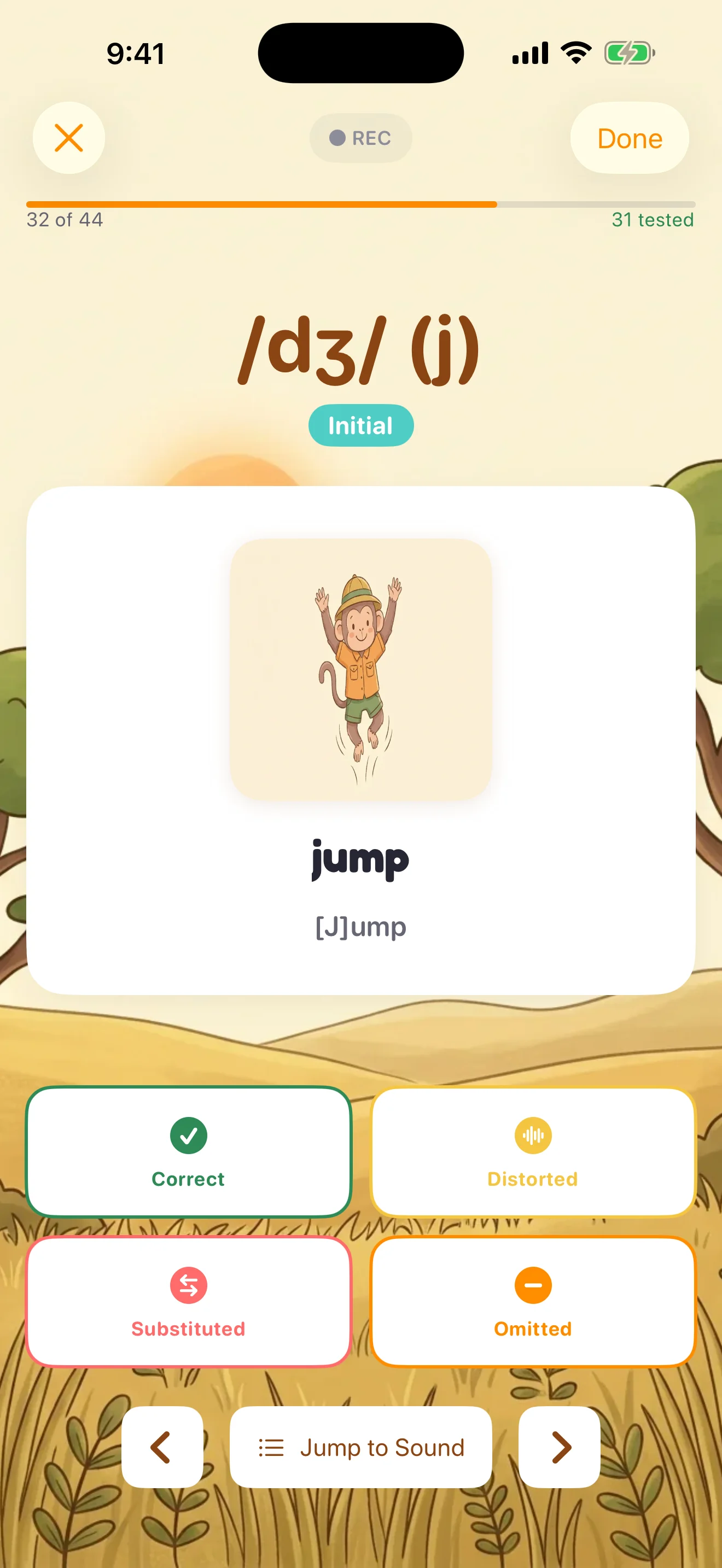
It covers all 24 English consonant sounds, each probed with a high-frequency stimulus word. Screening is intentionally limited to initial and final positions only — standard screening practice — which is what makes it fast, and what distinguishes it from the three-position word-level practice flow.
Each stimulus is more than a word. It pairs a target sound and position with:
- a high-frequency word,
- a picture / emoji,
- the IPA transcription, and
- alternative elicitation words if the first doesn’t pull the target.
For example, /p/ in the initial position is pig 🐷, with pie, pen, and paw on hand as alternatives when a child blanks on the first prompt.
Once you’ve scored the items, the screener does the interpretive step automatically. It compares each errored sound against the student’s age and that sound’s developmental norm, then sorts the results into three tiers:
- High — the sound should already be mastered at this age
- Medium — the sound is in the emerging window
- Low / Monitor — not yet developmentally expected
Those tiers are informational suggestions, not diagnostic conclusions — qualified professionals make the clinical call. As a workflow benefit, the built-in screener replaces $200+ standalone assessment tools (more on plans and team use on the pricing page).
From Screening Result to Next Step
Most checklists end at “consult a professional.” That’s a dead end, not a funnel. A screening produces one of three outcomes, and each has a clear next move:
| Outcome | What it means | Next step |
|---|---|---|
| Pass / monitor | Errors are age-appropriate | Re-screen on a cadence (e.g., next term) |
| Borderline | A few errors near the edge of expected | Watch, add targeted home practice, re-screen sooner |
| Refer | Errors past the expected age, or a lateral lisp | Recommend a full evaluation |
It’s worth being concrete about what a full evaluation adds over a screening, so a “refer” doesn’t feel alarming. The evaluation gives standardized scores against same-age peers, a formal written report, and an eligibility determination — typically in about 45 minutes. To say it once more: a screening alone cannot qualify a child for services; the evaluation is what does.
For SLPs who decide to target a flagged sound, the screener’s recommendations connect directly to Sound Safari’s goal workflow. The built-in IEP goal bank ships editable templates across 8 SLP domains, including dedicated articulation and phonology sets you can launch straight from a screening result. The depth of goal-writing lives in our IEP goals for articulation guide — that’s where a flagged sound becomes a measurable, time-bound SMART goal.
A compliance note that anchors this whole section: norms and screening results inform eligibility; they do not decide it. Qualified professionals make clinical decisions.
Screening for SLPs vs. Parents: Same Checklist, Different Lens
This one checklist serves two readers. The lens differs; the underlying norms don’t.
For SLPs
Use the checklist for fast triage across a caseload at the start of a year or a new placement. The McLeod & Crowe ages give you defensible norms for documentation, and recording the error type gives you an error pattern you can probe and test for stimulability. When you screen in-app, the prioritized recommendations export into your goal and notes workflow, so a “refer” doesn’t sit in a vacuum — it becomes the first line of a plan. Eligibility caveats still apply: the screen flags, the evaluation decides.
For Parents
Most sound errors you hear are developmentally normal — that’s the headline. A 3-year-old who says “wed twuck” for red truck is squarely on track. This checklist exists to tell you when to ask a professional, not how to “fix” speech at home. Skip the temptation to drill sounds; the most useful thing you can do is run the age check and the intelligibility estimate, and treat the result as a starting point for a conversation, not a label.
A privacy note that applies to both readers: in Sound Safari, your clinical and student data stays on your device and your iCloud account — it never touches our servers. We recommend entering student initials rather than full names. Parents exploring the practice side can start at the parent overview.
Frequently Asked Questions
What is an articulation screening?
A quick, informal pass/refer check — usually 5 to 15 minutes — that answers one question: is there a speech-sound concern worth a closer look? It uses developmental norms and a short word sample, produces no standardized scores, and cannot diagnose a disorder or qualify a child for services.
What’s the difference between a speech screening and a full evaluation?
A screening is brief and informal (pass/refer, no scores). A full evaluation is comprehensive: it gives standardized scores against same-age peers, a formal written report, and an eligibility determination, and usually runs about 45 minutes. A screening flags whether an evaluation is warranted; only the evaluation can diagnose or qualify a child for services.
What sounds should a 3, 4, or 5 year old be able to say?
Using McLeod & Crowe (2018) 90% mastery ages: by 3;0, expect /p, b, d, m, n, h, w/. By 4;0, add /t, k, g, ng, f, y/. By 5;0, expect most remaining consonants — /s, l, sh, ch, j, v, z/. Sounds like /r/ and /th/ develop later. Most consonants are in place by 5;0 and all by 7;0.
How much of my child’s speech should a stranger understand by each age?
Commonly cited developmental benchmarks: roughly 50% intelligible to unfamiliar listeners by age 2, about 75% by age 3, and approaching 100% by age 4 (newer growth-curve data — Hustad et al., 2021 — finds many typical 4-year-olds still nearer 75–80% in conversation). The firm flag: a child over 4;0 whom strangers understand less than about two-thirds of the time is a candidate for further evaluation.
Is a lisp normal, and at what age should I worry?
An interdental (frontal) lisp, where the tongue pokes between the teeth on /s/ and /z/, is developmentally typical up to about 4;6 to 5;0. A lateral lisp — a slushy sound with air escaping over the sides of the tongue — is never developmentally typical at any age and rarely resolves on its own, so it warrants referral whenever it is identified.
How long does an articulation screening take, and can it diagnose a speech disorder?
A screening typically takes 5 to 15 minutes. It cannot diagnose a speech disorder or qualify a child for services — it only flags whether a full evaluation is warranted. Sound Safari is a clinical tool, not a medical device; it does not provide diagnoses or treatment recommendations.
What happens if a child does not pass a speech screening?
A “refer” result simply means a closer look is warranted — it is not a diagnosis. The next step is a full evaluation by a licensed SLP, which uses standardized testing to determine whether a disorder is present and whether the child qualifies for services.
Can I do an articulation screening at home?
Yes, as an informal check. Use this age-grouped checklist plus an intelligibility estimate from a short connected-speech sample. It can tell you whether to start a conversation with a professional, but it is not a substitute for a licensed SLP’s evaluation. A digital screener like Sound Safari’s can make the same check faster and keep the results next to a child’s goals.