Sound Safari
SLPs spend roughly a third of their working time on documentation, and IEP writing is the slowest, most deliberate piece of it. The blank page is the hardest part: once you have a well-formed goal in front of you, editing is easy. This article gives you 50+ copy-paste-ready SMART articulation goals, organized by the specific sound you’re targeting. Each goal includes a suggested baseline range, accuracy target, and estimated timeframe so you can drop it into a document and adjust to your student’s data rather than starting from scratch.
The templates reflect Crowe & McLeod (2020) U.S. developmental norms — the current standard review of American English consonant acquisition, a U.S.-specific companion to the authors’ 2018 cross-linguistic (27-language) review — and follow the SMART structure ASHA-practicing SLPs already use. You’ll find goals for isolation, syllable, word, phrase, sentence, and conversation levels; blend and cluster goals; phonological process goals; and carryover/generalization templates for when a student hits mastery in session but regresses at home or in the classroom.
Every goal in this article is a template. It is not a substitute for clinical judgment, baseline data, or your district’s specific IEP conventions. Use these as a starting point and customize the accuracy criteria, timeframes, and contexts to match the student you’re writing the goal for.
The SMART Goal Formula
Every goal in this article conforms to SMART structure. If you are reviewing someone else’s IEP or auditing your own, it helps to have the framework explicit:
- S — Specific. Name the sound, position, and context. “Produce /r/” is not specific. “Produce prevocalic /r/ in the initial position of single-syllable words” is specific.
- M — Measurable. Accuracy percentage, number of trials, and criterion type. “80% accuracy across 20 trials in 3 of 4 consecutive sessions” is measurable. “Demonstrates improvement” is not.
- A — Achievable. The goal must be within reach given the student’s age, developmental norms, and the length of the IEP period. Writing a spontaneous-conversation /r/ goal for a student whose baseline is 10% at the isolation level is not achievable in one year.
- R — Relevant. Tie the goal to a communicative need. “To improve participation in classroom discussions” or “to be understood by unfamiliar listeners in 85% of conversational contexts” connects the sound to a real outcome. A goal without relevance is a drill.
- T — Time-bound. An explicit timeframe — “by the end of the IEP year,” “within 30 weeks of instruction,” “by June 15, 2027.” Vague timeframes cause disputes at review meetings.
Here is one articulation goal broken into its SMART components so you can see the structure at a glance:
Goal: Given a verbal model and picture cues, [Student] will produce the /s/ sound in the initial position of single-syllable words with 80% accuracy across 20 trials in 3 of 4 consecutive sessions by the end of the IEP year, to improve intelligibility during classroom participation.
- S (Specific): /s/, initial position, single-syllable words, with verbal model and picture cues
- M (Measurable): 80% accuracy, 20 trials, 3 of 4 consecutive sessions
- A (Achievable): age-appropriate if student is 5;0+, consistent with Crowe & McLeod norms
- R (Relevant): tied to classroom participation
- T (Time-bound): by the end of the IEP year
Before writing a goal, confirm the sound is developmentally appropriate to target. The next section lays out the mastery ages you need.
Speech Sound Development Chart
Developmental norms determine whether a sound is IEP-candidate in the first place. The table below summarizes the U.S. English consonant mastery ages from Crowe & McLeod’s 2020 review — the U.S.-specific companion to their 2018 cross-linguistic (27-language) review. “50% mastery” is the age at which half of typically-developing children produce the sound correctly; “90% mastery” is when 90% do. SLPs most often use the 90% column as the clinical threshold: if a child is past the 90% age and still errors the sound, it’s typically a reasonable IEP target.
A note on the age format. Ages below are shown in the standard speech-pathology
years;monthsnotation — not a decimal. So3;6means 3 years, 6 months old, not 3.6 years.4;0means 4 years, 0 months (just turned 4).
| Sound(s) | 50% mastery age | 90% mastery age | Typically IEP-candidate if child is… |
|---|---|---|---|
| /p/ | 1;6 | 3;0 | Age 3;0 or older and not producing |
| /b/, /d/, /m/, /n/, /h/, /w/ | 2;0 | 3;0 | Age 3;0 or older and not producing |
| /t/, /k/, /g/, /ng/ | 2;0 | 4;0 | Age 4;0 or older and not producing |
| /f/, /y/ | 2;6 | 4;0 | Age 4;0 or older and not producing |
| /l/ | 3;0 | 5;0 | Age 5;0 or older and not producing |
| /s/ | 3;0 | 5;0 | Age 5;0 or older and not producing |
| /sh/, /ch/, /j/ | 3;6 | 5;0 | Age 5;0 or older and not producing |
| /v/, /z/ | 4;0 | 5;0 | Age 5;0 or older and not producing |
| /r/ | 4;0 | 6;0 | Age 6;0 or older and not producing |
| /th/ (voiced, as in this) | 4;0 | 6;0 | Age 6;0 or older and not producing |
| /zh/ (as in measure) | 5;0 | 6;0 | Age 6;0 or older and not producing |
| /th/ (voiceless, as in thumb) | 4;0 | 7;0 | Age 7;0 or older and not producing |
Source: Crowe, K., & McLeod, S. (2020). Children’s English consonant acquisition in the United States: A review. American Journal of Speech-Language Pathology, 29(4), 2155–2169. (U.S.-specific companion to McLeod, S., & Crowe, K. (2018), Children’s consonant acquisition in 27 languages: A cross-linguistic review, AJSLP, 27(4), 1546–1571.)
Two caveats worth being explicit about before you hand this table to a parent or administrator:
- Under 90% mastery age does not automatically mean no IEP. A 3;6-year-old who is still fronting /k/ and /g/ and also unintelligible to unfamiliar listeners needs direct service even though /k/ and /g/ are still within the typical acquisition window for some children. Eligibility always combines norms with stimulability, intelligibility impact, and the student’s or family’s priorities.
- Past the 90% mastery age does not automatically mean an IEP is required. A 7-year-old with a mild lateral /s/ distortion who is fully intelligible and uninterested in therapy may not meet eligibility under your district’s criteria. The norms inform eligibility; they don’t decide it.
Use the table as a first-pass filter, then apply clinical judgment.
Goals by Sound
This is the core of the article. For each of the nine most commonly-targeted articulation sounds, you’ll find 4–5 goal templates progressing from the simplest context (isolation or syllable) to the most complex (spontaneous conversation). Copy a template, adjust the baseline and timeframe to match your student’s data, and drop it into the IEP document.
The per-sound sections are designed to be self-contained — skip to the sound you’re writing about. Each section opens with a short clinical note covering the sound’s key substitutions, typical error patterns, and anything distinctive that affects how you write the goal.
IEP Goals for /r/
The /r/ sound is one of the most frequently mistargeted sounds on SLP caseloads, and the most variable in presentation. There are 21 distinct /r/ allophones in American English when you account for prevocalic /r/, vocalic /r/ (the “er” sound in bird), and /r/ blends. The most common substitution is the /w/ glide (“wed” for red), followed by various distortions. 50% mastery is 4;0; 90% mastery is 6;0. A child who is 6;0 or older and still substituting /w/ or producing a distorted vocalic /r/ is typically IEP-candidate. For a full breakdown of the 7 vocalic R contexts, retroflex vs bunched tongue placement, and the therapy hierarchy that pairs with these goals, see our /r/ sound therapy guide.
Goal 1 (Isolation / early stimulability): Given a verbal model and tactile/visual cues, [Student] will produce the /r/ sound in isolation with 80% accuracy across 20 trials in 3 of 4 consecutive sessions by the end of the IEP year. Suggested baseline: 0–30%. Timeframe: 8–12 weeks.
Goal 2 (Syllable level): [Student] will produce prevocalic /r/ in CV and VC syllables (e.g., /ra/, /ri/, /ro/, /ir/, /ar/) with 85% accuracy across 20 trials in 3 of 4 consecutive sessions by the end of the IEP year. Suggested baseline: 20–40%. Timeframe: 10–14 weeks.
Goal 3 (Word level, initial position): [Student] will produce /r/ in the initial position of single-syllable and two-syllable words (e.g., red, run, rabbit, river) with 80% accuracy across 20 trials in 3 of 4 consecutive sessions by the end of the IEP year. Suggested baseline: 30–50%. Timeframe: 12–18 weeks.
Goal 4 (Phrase and structured sentence): Given picture cues and a carrier phrase (“I see a ___”), [Student] will produce /r/ in the initial and medial positions of target words within structured sentences with 80% accuracy across 20 trials in 3 of 4 consecutive sessions by the end of the IEP year. Suggested baseline: 40–60%. Timeframe: 14–20 weeks.
Goal 5 (Spontaneous conversation / generalization): During 3-minute spontaneous conversational samples on topics of the student’s choice, [Student] will produce /r/ correctly in all word positions with 75% accuracy, as measured by narrative retell or structured discourse probe, by the end of the IEP year. Suggested baseline: 50–65%. Timeframe: 18–32 weeks.
IEP Goals for /s/
/s/ errors most often present as either an interdental lisp (tongue protruding between teeth, producing a /θ/-like sound: “thun” for sun) or a lateral lisp (air escaping over the sides of the tongue, producing a “slushy” quality). Lateral lisps are considered more persistent and harder to remediate. 50% mastery is 3;0; 90% mastery is 5;0. A 5-year-old with a noticeable /s/ error is typically IEP-candidate. For a deep dive into the frontal-vs-lateral distinction, shaping techniques for each lisp type, word lists by position, and minimal-pair practice, see our /s/ sound therapy guide.
Goal 1 (Isolation): Given verbal and visual models, [Student] will produce a precise /s/ sound in isolation, without interdental or lateral distortion, with 85% accuracy across 20 trials in 3 of 4 consecutive sessions by the end of the IEP year. Suggested baseline: 10–30%. Timeframe: 6–10 weeks.
Goal 2 (Syllable and CV/VC level): [Student] will produce /s/ in CV, VC, and CVC syllables (e.g., /sa/, /is/, /sus/) with a precise (non-lateral, non-interdental) tongue position 80% of the time across 20 trials in 3 of 4 consecutive sessions. Suggested baseline: 20–40%. Timeframe: 8–12 weeks.
Goal 3 (Word level, all positions): [Student] will produce /s/ in the initial, medial, and final positions of single-syllable words (e.g., sun, icy, bus) with 80% accuracy across 20 trials in 3 of 4 consecutive sessions. Suggested baseline: 30–50%. Timeframe: 12–16 weeks.
Goal 4 (Structured sentence level): Given picture cues and a structured sentence frame, [Student] will produce /s/ in all word positions within sentences with 80% accuracy across 20 trials in 3 of 4 consecutive sessions. Suggested baseline: 40–55%. Timeframe: 14–20 weeks.
Goal 5 (Conversation): During 3-minute conversational samples on age-appropriate topics, [Student] will produce /s/ correctly with 75% accuracy, with no observable lateral or interdental distortion, by the end of the IEP year. Suggested baseline: 50–65%. Timeframe: 18–28 weeks.
IEP Goals for /l/
/l/ errors most often present as a /w/ substitution (“wion” for lion) or a vowelized /l/ (where the tongue fails to contact the alveolar ridge and the sound becomes vowel-like). 50% mastery is 3;0; 90% mastery is 5;0. A 5-year-old still substituting /w/ for /l/ is typically IEP-candidate. For a deep dive on light-/l/ vs dark-/l/ placement, /l/-blends as a distinct therapy track, and home practice strategies, see our /l/ sound therapy guide.
Goal 1 (Isolation): Given a verbal model, [Student] will produce /l/ in isolation with the tongue tip elevated to the alveolar ridge with 85% accuracy across 20 trials in 3 of 4 consecutive sessions. Suggested baseline: 0–30%. Timeframe: 6–10 weeks.
Goal 2 (Syllable and word level, initial): [Student] will produce /l/ in the initial position of CV syllables and single-syllable words (e.g., /la/, /lo/, lip, leaf) with 80% accuracy across 20 trials in 3 of 4 consecutive sessions. Suggested baseline: 25–45%. Timeframe: 10–14 weeks.
Goal 3 (Word level, all positions): [Student] will produce /l/ in the initial, medial, and final positions of single-syllable and two-syllable words with 80% accuracy across 20 trials in 3 of 4 consecutive sessions. Suggested baseline: 35–55%. Timeframe: 12–18 weeks.
Goal 4 (Structured sentence): Given a sentence frame and picture cues, [Student] will produce /l/ in structured sentences with 80% accuracy across 20 trials in 3 of 4 consecutive sessions. Suggested baseline: 45–60%. Timeframe: 14–20 weeks.
Goal 5 (Conversation): During 3-minute conversational samples, [Student] will produce /l/ correctly in all word positions with 75% accuracy by the end of the IEP year. Suggested baseline: 55–70%. Timeframe: 16–26 weeks.
IEP Goals for /th/
/th/ has two variants: voiceless /θ/ (as in thumb) and voiced /ð/ (as in this). Both are commonly substituted by /f/ or /v/ respectively (“fum” for thumb, “vis” for this) or by /t/ or /d/. 50% mastery is 4;0 for both variants; 90% mastery is 6;0 for voiced /ð/ and 7;0 for voiceless /θ/. Voiceless /θ/ has the latest acquisition age of any English consonant, so clinicians often wait longer before intervening.
Goal 1 (Isolation, voiceless /θ/): Given a verbal model and tactile cues (tongue tip between teeth), [Student] will produce /θ/ in isolation with 85% accuracy across 20 trials in 3 of 4 consecutive sessions. Suggested baseline: 0–25%. Timeframe: 6–10 weeks.
Goal 2 (Isolation, voiced /ð/): [Student] will produce /ð/ in isolation with visible tongue-tip placement and voicing with 85% accuracy across 20 trials in 3 of 4 consecutive sessions. Suggested baseline: 0–25%. Timeframe: 6–10 weeks.
Goal 3 (Word level): [Student] will produce both /θ/ and /ð/ in the initial, medial, and final positions of single-syllable and two-syllable words (e.g., thumb, bath, this, bathe) with 80% accuracy across 20 trials in 3 of 4 consecutive sessions. Suggested baseline: 20–40%. Timeframe: 14–22 weeks.
Goal 4 (Sentence): Given structured sentence frames, [Student] will produce /θ/ and /ð/ in all word positions within sentences with 80% accuracy across 20 trials in 3 of 4 consecutive sessions. Suggested baseline: 35–55%. Timeframe: 16–24 weeks.
Goal 5 (Conversation): During 3-minute conversational samples, [Student] will produce /θ/ and /ð/ correctly in all word positions with 75% accuracy by the end of the IEP year. Suggested baseline: 45–60%. Timeframe: 20–32 weeks.
IEP Goals for /k/
/k/ errors are most often the result of the fronting phonological process — the student substitutes an alveolar /t/ for the velar /k/ (“tat” for cat). Fronting is one of the most common phonological processes in preschool-age children. 50% mastery is 2;0; 90% mastery is 4;0. A 4-year-old who is still fronting is typically IEP-candidate, and the goal may be framed either as an articulation goal (see below) or as a phonological process goal (see the Phonological Process Goals section).
Goal 1 (Isolation): Given a verbal model and tactile cues (tongue body contacts velum), [Student] will produce /k/ in isolation with 85% accuracy across 20 trials in 3 of 4 consecutive sessions. Suggested baseline: 0–30%. Timeframe: 6–10 weeks.
Goal 2 (Syllable and CV level, initial): [Student] will produce /k/ in CV syllables and in the initial position of single-syllable words (e.g., cat, cup, key) without fronting, with 80% accuracy across 20 trials in 3 of 4 consecutive sessions. Suggested baseline: 20–45%. Timeframe: 10–14 weeks.
Goal 3 (Word level, all positions): [Student] will produce /k/ in the initial, medial, and final positions of single-syllable and two-syllable words with 80% accuracy across 20 trials in 3 of 4 consecutive sessions. Suggested baseline: 30–55%. Timeframe: 12–18 weeks.
Goal 4 (Sentence level): Given a sentence frame and picture cues, [Student] will produce /k/ in all word positions within structured sentences with 80% accuracy across 20 trials in 3 of 4 consecutive sessions. Suggested baseline: 40–60%. Timeframe: 14–20 weeks.
Goal 5 (Conversation): During 3-minute conversational samples, [Student] will produce /k/ correctly in all word positions with 75% accuracy by the end of the IEP year. Suggested baseline: 50–65%. Timeframe: 16–24 weeks.
IEP Goals for /g/
/g/ errors typically pair with /k/ errors as part of the same fronting pattern (student substitutes /d/ for /g/: “doe” for go). When /k/ and /g/ both front, a phonological process goal covering both velars is usually more efficient than two parallel articulation goals. 50% mastery is 2;0; 90% mastery is 4;0.
Goal 1 (Isolation): Given a verbal model, [Student] will produce /g/ in isolation with voicing and correct velar placement with 85% accuracy across 20 trials in 3 of 4 consecutive sessions. Suggested baseline: 0–30%. Timeframe: 6–10 weeks.
Goal 2 (Syllable level): [Student] will produce /g/ in CV syllables (e.g., /ga/, /go/, /gu/) without fronting, with 80% accuracy across 20 trials in 3 of 4 consecutive sessions. Suggested baseline: 20–40%. Timeframe: 8–12 weeks.
Goal 3 (Word level, all positions): [Student] will produce /g/ in the initial, medial, and final positions of single-syllable and two-syllable words (e.g., go, wagon, bag) with 80% accuracy across 20 trials in 3 of 4 consecutive sessions. Suggested baseline: 30–50%. Timeframe: 12–18 weeks.
Goal 4 (Sentence level): Given a sentence frame and picture cues, [Student] will produce /g/ in all word positions within structured sentences with 80% accuracy across 20 trials in 3 of 4 consecutive sessions. Suggested baseline: 40–55%. Timeframe: 14–20 weeks.
Goal 5 (Conversation): During 3-minute conversational samples, [Student] will produce /g/ correctly in all word positions with 75% accuracy by the end of the IEP year. Suggested baseline: 50–65%. Timeframe: 16–24 weeks.
IEP Goals for /f/
/f/ errors most often present as a /p/ substitution from the stopping phonological process (“pish” for fish) or, less commonly, a distortion. 50% mastery is 2;6; 90% mastery is 4;0.
Goal 1 (Isolation): Given a verbal model (top teeth lightly on lower lip with airflow), [Student] will produce /f/ in isolation with 85% accuracy across 20 trials in 3 of 4 consecutive sessions. Suggested baseline: 0–30%. Timeframe: 6–8 weeks.
Goal 2 (Syllable and word level, initial): [Student] will produce /f/ in CV syllables and in the initial position of single-syllable words (e.g., fish, fun, four) with 80% accuracy across 20 trials in 3 of 4 consecutive sessions. Suggested baseline: 20–45%. Timeframe: 10–14 weeks.
Goal 3 (Word level, all positions): [Student] will produce /f/ in the initial, medial, and final positions of single-syllable and two-syllable words with 80% accuracy across 20 trials in 3 of 4 consecutive sessions. Suggested baseline: 35–55%. Timeframe: 12–16 weeks.
Goal 4 (Sentence level): Given a sentence frame, [Student] will produce /f/ in all word positions within structured sentences with 80% accuracy across 20 trials in 3 of 4 consecutive sessions. Suggested baseline: 45–60%. Timeframe: 14–20 weeks.
Goal 5 (Conversation): During 3-minute conversational samples, [Student] will produce /f/ correctly with 75% accuracy by the end of the IEP year. Suggested baseline: 55–70%. Timeframe: 16–22 weeks.
IEP Goals for /sh/
/sh/ (the /ʃ/ phoneme) is often substituted by /s/ (“sip” for ship) — a process called depalatalization — or produced with a distorted tongue shape. 50% mastery is 3;6; 90% mastery is 5;0.
Goal 1 (Isolation): Given a verbal model and visual cues (rounded lips, tongue slightly back of alveolar ridge), [Student] will produce /ʃ/ in isolation with 85% accuracy across 20 trials in 3 of 4 consecutive sessions. Suggested baseline: 10–30%. Timeframe: 6–10 weeks.
Goal 2 (Syllable and word level, initial): [Student] will produce /ʃ/ in CV syllables and in the initial position of single-syllable words (e.g., ship, shoe, shine) with 80% accuracy across 20 trials in 3 of 4 consecutive sessions. Suggested baseline: 25–45%. Timeframe: 10–14 weeks.
Goal 3 (Word level, all positions): [Student] will produce /ʃ/ in the initial, medial, and final positions of single-syllable and two-syllable words (e.g., shine, washing, fish) with 80% accuracy across 20 trials in 3 of 4 consecutive sessions. Suggested baseline: 35–55%. Timeframe: 12–16 weeks.
Goal 4 (Sentence level): Given a sentence frame, [Student] will produce /ʃ/ in all word positions within structured sentences with 80% accuracy across 20 trials in 3 of 4 consecutive sessions. Suggested baseline: 45–60%. Timeframe: 14–20 weeks.
Goal 5 (Conversation): During 3-minute conversational samples, [Student] will produce /ʃ/ correctly with 75% accuracy by the end of the IEP year. Suggested baseline: 55–70%. Timeframe: 16–24 weeks.
IEP Goals for /ch/
/ch/ (the /tʃ/ affricate) and /j/ (the /dʒ/ affricate) are often substituted by /sh/ or /s/ (“ship” for chip). 50% mastery is 3;6; 90% mastery is 5;0.
Goal 1 (Isolation): Given a verbal model, [Student] will produce the /tʃ/ affricate in isolation with correct stop-plus-fricative sequencing with 85% accuracy across 20 trials in 3 of 4 consecutive sessions. Suggested baseline: 10–30%. Timeframe: 6–10 weeks.
Goal 2 (Syllable and word level, initial): [Student] will produce /tʃ/ in CV syllables and in the initial position of single-syllable words (e.g., chip, cheese, chair) with 80% accuracy across 20 trials in 3 of 4 consecutive sessions. Suggested baseline: 25–45%. Timeframe: 10–14 weeks.
Goal 3 (Word level, all positions): [Student] will produce /tʃ/ in the initial, medial, and final positions of single-syllable and two-syllable words (e.g., chip, teacher, beach) with 80% accuracy across 20 trials in 3 of 4 consecutive sessions. Suggested baseline: 35–55%. Timeframe: 12–18 weeks.
Goal 4 (Sentence level): Given a sentence frame, [Student] will produce /tʃ/ in all word positions within structured sentences with 80% accuracy across 20 trials in 3 of 4 consecutive sessions. Suggested baseline: 45–60%. Timeframe: 14–20 weeks.
Goal 5 (Conversation): During 3-minute conversational samples, [Student] will produce /tʃ/ correctly with 75% accuracy by the end of the IEP year. Suggested baseline: 55–70%. Timeframe: 16–24 weeks.
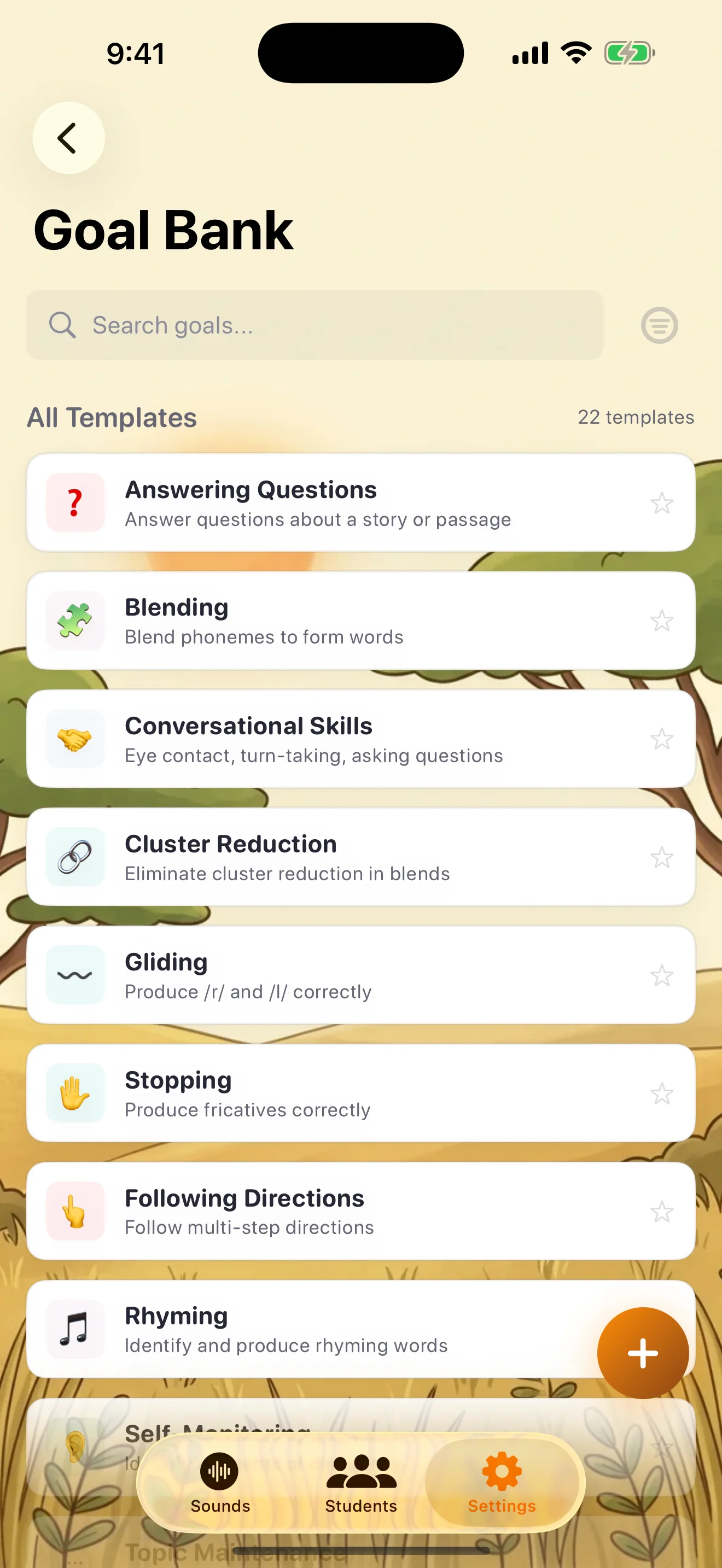
Writing these goals by hand is one thing — tracking accuracy against them session by session is where the real administrative load lives. Sound Safari links session data directly to the IEP goals you’ve written, so the probe data for every goal is up to date without manual re-entry.
Blend and Cluster Goals
Consonant blends (two or more consonants produced in sequence without an intervening vowel) are clinically distinct from single phonemes. A student who can produce /s/ and /p/ in isolation may still reduce /sp/ blends to /p/ (“poon” for spoon). Cluster reduction is its own phonological process, and it’s common in children up to about age 4. Past 90% mastery for both component sounds, blends become an independent therapy target.
The three most commonly targeted blend families are /r/-blends, /s/-blends, and /l/-blends.
Goal (generic /r/-blends): [Student] will produce /r/-blends (/br/, /cr/, /dr/, /fr/, /gr/, /pr/, /tr/) in the initial position of single-syllable words (e.g., brown, crab, tree) with 80% accuracy across 20 trials in 3 of 4 consecutive sessions by the end of the IEP year. Suggested baseline: 20–45%. Timeframe: 12–18 weeks.
Goal (generic /s/-blends): [Student] will produce /s/-blends (/sp/, /st/, /sk/, /sl/, /sm/, /sn/, /sw/) in the initial position of single-syllable words (e.g., spoon, star, slide) with 80% accuracy across 20 trials in 3 of 4 consecutive sessions. Suggested baseline: 25–45%. Timeframe: 12–16 weeks.
Goal (generic /l/-blends): [Student] will produce /l/-blends (/bl/, /cl/, /fl/, /gl/, /pl/, /sl/) in the initial position of single-syllable words (e.g., blue, clap, plane) with 80% accuracy across 20 trials in 3 of 4 consecutive sessions. Suggested baseline: 25–45%. Timeframe: 12–16 weeks.
Goal (three-element blends): [Student] will produce three-element /s/-blends (/spl/, /spr/, /str/, /skr/) in the initial position of single-syllable words with 80% accuracy across 20 trials in 3 of 4 consecutive sessions. Suggested baseline: 15–40%. Timeframe: 14–20 weeks.
Goal (blends in sentences): Given a sentence frame, [Student] will produce targeted consonant blends in structured sentences with 80% accuracy across 20 trials in 3 of 4 consecutive sessions by the end of the IEP year. Suggested baseline: 40–55%. Timeframe: 16–22 weeks.
Cluster accuracy almost always lags single-phoneme accuracy by 10–15 percentage points at the same level; adjust baseline ranges accordingly.
Phonological Process Goals
Phonological process goals target a pattern of errors across multiple sounds rather than a single sound. They are usually more efficient than writing parallel articulation goals when the error pattern is predictable. The four most commonly targeted processes in school-based therapy are fronting, stopping, cluster reduction, and gliding. For a full clinical breakdown of all 8 common phonological processes with age-of-resolution norms, identification steps, and therapy approaches (cycles, minimal pairs, targeted), see our phonological processes guide.
Goal (fronting): [Student] will reduce the fronting phonological process by producing velar sounds /k/ and /g/ (substituted for /t/ and /d/) in the initial and medial positions of words with 80% accuracy across 20 trials in 3 of 4 consecutive sessions by the end of the IEP year. Suggested baseline: 20–45%. Timeframe: 14–22 weeks.
Goal (stopping): [Student] will reduce the stopping phonological process by producing fricatives /f/, /v/, /s/, /z/, /ʃ/ (substituted for stops /p/, /b/, /t/, /d/) in the initial position of single-syllable words with 80% accuracy across 20 trials in 3 of 4 consecutive sessions. Suggested baseline: 20–40%. Timeframe: 14–22 weeks.
Goal (cluster reduction): [Student] will reduce the cluster reduction phonological process by producing the full two-element consonant cluster in the initial position of single-syllable words with 80% accuracy across 20 trials in 3 of 4 consecutive sessions. Suggested baseline: 25–45%. Timeframe: 12–18 weeks.
Goal (gliding): [Student] will reduce the gliding phonological process by producing the liquid sounds /r/ and /l/ (rather than gliding to /w/) in the initial position of single-syllable words with 80% accuracy across 20 trials in 3 of 4 consecutive sessions. Suggested baseline: 20–40%. Timeframe: 16–24 weeks.
A quick rule of thumb for process vs. articulation goal selection: if the child substitutes a predictable set of sounds in a predictable pattern, write a process goal. If the child distorts a single sound without a pattern affecting other sounds, write an articulation goal. Some students need both — a process goal covering the pattern and an articulation goal for a separate distortion that doesn’t fit the pattern.
This article focuses on articulation and phonology. Language, fluency, voice, and pragmatic goals will be covered in separate future articles on this site.
Goal Progression: From Isolation to Conversation
Every goal in this article implicitly uses the same six-level progression of linguistic complexity. Understanding the progression explicitly helps you decide whether to write one goal that scales levels over the IEP year or five separate sequential goals.
- Isolation — the sound produced alone, without an adjacent vowel or consonant. Pure phonetic practice.
- Syllable — CV, VC, or CVC combinations with the target sound (e.g., /ra/, /ir/, /rar/). Adds the motor challenge of coarticulation.
- Word level (by position) — the target sound in real words, subdivided by position: initial, medial, and final. Most goals target initial position first because it’s typically easiest.
- Phrase and structured sentence — the target sound inside a carrier phrase (“I see a ___”) and then in structured sentence frames. Linguistic context starts to interfere with motor accuracy.
- Structured conversation — narrative retell, Q&A on a known topic, or topic-constrained discourse. Multiple opportunities for the sound within planned utterances.
- Spontaneous conversation — open-topic conversation, the generalization target.
Two ways to write the goal sequence:
- One goal that progresses levels, with benchmarks at each level. Example: “By the end of the IEP year, [Student] will produce /r/ at the conversational level with 75% accuracy, progressing through word, phrase, sentence, and structured conversation levels with documented benchmark data at each.” This is cleaner on the IEP document but requires explicit benchmark tracking in session notes.
- Five sequential goals, one per level, each with its own accuracy and timeframe. This produces a longer IEP document but makes progress easier to track in standard tools.
Which approach to choose usually depends on your district’s IEP format and how your data system records progress. Both are clinically defensible.
Generalization and Carryover Strategies
A student who scores 90% on /r/ in a structured session and 40% in classroom conversation has not generalized — they have mastered the drill, not the sound. Generalization is the most commonly-missed aspect of articulation goals, and the research gap for it in published goal banks is real. Here are the five strategies that typically move the needle.
Home practice lists by position. Send the family a word list organized by position (initial, medial, final) with 10–15 target words per position. Ask them to do 3–5 minutes of practice 4 times per week. Short, frequent practice beats long, occasional sessions for motor learning. For parents who aren’t sure where to start, Sound Safari’s parent app walks through home practice with visual feedback so nothing is left to interpretation.
Parent training on modeling vs. correcting. Parents often default to constant correction (“say it again, say it right”), which increases frustration and decreases spontaneous speech. Train parents to model the correct production 2–3 times in a natural way without demanding repetition. Save explicit correction for specific practice times, not general conversation.
Classroom consultation. Share the target sound with the classroom teacher and provide a one-page handout listing (1) the sound, (2) what the error sounds like, (3) one strategy for natural-context modeling, and (4) what NOT to do. Add a brief classroom observation every 4–6 weeks to collect generalization probe data in the natural setting.
Self-monitoring. By around age 7, most students can begin catching their own errors in real time. Introduce a simple self-monitoring system — a tally on a 3x5 card, a thumbs-up/thumbs-down gesture, or a sentence-by-sentence replay. Metacognition about the sound is a strong predictor of generalization.
Probe-based generalization data. Every 4–6 weeks, collect a short conversational sample outside the therapy room — classroom observation, home audio recording if the family is comfortable, a hallway check-in. Compare accuracy to your in-session probe. More than a 15-point drop is a signal to add a generalization goal rather than close the articulation goal.
The hardest part of generalization is not doing it — it’s tracking it. If practice happens at home and classroom observations happen during lunch, the data easily gets lost. Logging carryover probes against specific IEP goals (rather than in a separate notebook) is the difference between a defensible generalization claim and a vibe.
Progress Monitoring and Data Collection
Writing good IEP goals is half of the work. The other half is collecting data that proves progress against them. Here are the conventions most school-based SLPs follow.
Probe frequency. Most SLPs probe active goals weekly — one 20-trial probe at the current complexity level, with accuracy calculated as (correct productions / total opportunities) × 100. Goals in active acquisition benefit from weekly data; goals in maintenance can drop to monthly.
Probe length. A 20-trial probe is standard, but 10 trials is acceptable for very young students or students with short attention spans. Shorter probes have more statistical noise, so plot them as a running average over 3 sessions instead of reading each probe in isolation.
Mastery criterion. 80% accuracy across 20 trials in 3 of 4 consecutive sessions is the most common criterion. Some clinicians write 85% for younger kids at the isolation level and 75% at the conversational level to reflect the difficulty of each context. Pick whatever matches your district and be consistent.
Data collection format. The most useful format for articulation probes is a percentage per session, plotted on a simple line graph with the mastery line drawn across the top. Trends become visible in 4–6 data points.
When to modify a goal vs. continue. If a student is stuck at under 50% for 6+ weeks without upward trend, the goal is usually either not-yet-achievable (drop to a lower level) or the instructional approach needs to change (different cue, different target word set, different prompting hierarchy). Don’t let a stuck goal stay on the IEP for a full year without revision.
This is the administrative work that is both essential and the most time-consuming to do manually. Sound Safari generates SOAP notes and probe graphs automatically from session data, so accuracy percentages flow directly from practice sessions into the IEP document without retyping — closing the gap between doing the therapy and documenting it.
Frequently Asked Questions
What does SMART stand for in an IEP goal?
SMART is a goal-writing framework meaning Specific (which sound, which position, which context), Measurable (accuracy percentage, trial count, criterion type), Achievable (age-appropriate per developmental norms), Relevant (tied to the student’s communicative need), and Time-bound (explicit timeframe such as “by the end of the IEP year”). Every articulation goal in this article follows this structure.
How often should I probe articulation IEP goals?
Most SLPs probe active articulation goals weekly with a 20-trial probe at the current complexity level. Students with heavy caseloads or short sessions can use 10-trial probes without losing statistical meaning. Goals in maintenance (already met mastery) can drop to monthly probes. Plot accuracy on a simple line graph so patterns are visible at a glance.
When should I start targeting the /r/ sound?
The /r/ sound is considered IEP-candidate when a child is at or past the 90% mastery age of 6 years, 0 months and still substituting or distorting /r/ in a way that impacts intelligibility or classroom participation. Before age 6;0, /r/ errors are developmentally typical and generally do not warrant direct service unless the child is highly unintelligible or distressed about the error. For a deep dive into /r/ production — consonantal vs vocalic /r/, retroflex vs bunched tongue placement, the 7 vocalic R contexts, and home practice strategies — see our /r/ sound therapy guide.
What’s the difference between an articulation goal and a phonological process goal?
Articulation goals target a single sound produced correctly (e.g., “produce /k/ in word-initial position with 80% accuracy”). Phonological process goals target a pattern of errors across multiple sounds (e.g., “reduce fronting by producing velar sounds /k/ and /g/ instead of /t/ and /d/ with 80% accuracy”). Choose phonological-process framing when the child substitutes in a predictable pattern rather than distorting one isolated sound.
How do I write a baseline if the student just got on my caseload?
Run a 20-trial baseline probe at each level (isolation, syllable, word, sentence) using the target sound in the child’s most-affected positions. Record percentage accuracy at each level. The first level where the student scores under 80% is the starting point for the goal. Baseline ranges in this article (e.g., “baseline 20–40%”) reflect where most students typically enter each level — adjust to match your student’s actual data.
What’s a reasonable accuracy target for an articulation IEP goal?
80% across 20 trials in 3 of 4 consecutive sessions is the most common mastery criterion in school-based articulation therapy. Some clinicians write 85% or 90% for younger students at the isolation level and 75% at the spontaneous conversation level to reflect the difficulty of each context. Pick whichever matches your district’s norms and the student’s stimulability, but be consistent across the goal’s progression.
Can apps help with IEP goal practice and tracking?
Yes, well-designed practice apps can handle three of the most time-consuming parts of articulation therapy: generating word lists by sound and position, scoring trials during practice, and logging accuracy data that maps back to active IEP goals. Sound Safari, for example, auto-captures session data against goals you set up and generates SOAP notes from it, which reduces the documentation burden and keeps probe data current without manual re-entry.
What do I do if a student hits mastery but regresses outside therapy?
Regression outside the therapy room is a generalization problem, not a mastery problem. Before declaring the original goal met, collect a sample of the sound in a different context — classroom observation, conversational probe, home audio — and compare accuracy. If accuracy drops more than ~15 points in untrained contexts, add a generalization goal targeting the untrained setting rather than closing the articulation goal. See the generalization section above for specific template language.
Closing
That’s 50+ SMART-formatted IEP goal templates covering the nine most commonly-targeted articulation sounds, the three main blend families, and the four most common phonological processes — all with baseline ranges, accuracy targets, and suggested timeframes you can drop into an IEP document. The templates are starting points, not prescriptions; adjust the criteria and contexts to match your student’s data and your district’s conventions.
If you want to close the gap between writing these goals and tracking progress against them, Sound Safari is built specifically for articulation therapy: an IEP goal bank, a 44-sound screener, auto-generated SOAP notes from session data, and a parent homework feature that captures practice data from outside the therapy room. Fourteen-day free trial, cancel anytime through Apple.