Sound Safari
The /r/ sound is the single most commonly treated articulation target in American English speech therapy, and it is also the most persistent. A child who says “wabbit” at age 4 is developmentally on track; the same child saying “wabbit” at age 7 is usually IEP-candidate. This guide covers what every parent and SLP should know about /r/ — why it’s so hard, how to recognize whether a child’s /r/ needs therapy, the two correct tongue placements, the seven vocalic R contexts, the therapy progression that works, and the home practice strategies that actually move the needle.
This is a hybrid guide. Parents will find the “what” and “why” sections accessible without a clinical background. SLPs will find the “how” sections — tongue placement, therapy hierarchy, minimal pairs, and word lists — detailed enough to reference in sessions. Skip to the section you need; every major topic has its own heading.
What is rhotacism?
Rhotacism is the clinical term for any speech-sound disorder involving /r/. The most common presentation is substituting /w/ for /r/, which produces “wabbit” for rabbit, “wed” for red, or “caw” for car. Less common presentations include substituting /l/ for /r/ (“labbit”), distorting /r/ so it lacks its characteristic “r-coloring” (a pattern called derhotacization), or deleting /r/ entirely (“abbit”).
The word sounds more formal than the condition warrants. Most children have some form of rhotacism at some point in development; it’s the default pattern while the /r/ articulation is being learned. What distinguishes a developmental /r/ error from a clinical one is persistence past the typical mastery age, combined with a functional impact on the child’s intelligibility or confidence.
This article uses “rhotacism” and “/r/ errors” interchangeably. They mean the same thing.
Developmental norms: when /r/ becomes an IEP concern
Developmental norms tell you whether a child’s /r/ error is still typical or is lagging behind peers. The consonant acquisition data from Crowe & McLeod’s 2020 U.S. review — the U.S.-specific companion to their 2018 cross-linguistic (27-language) review — puts American English /r/ mastery at:
| Metric | Age |
|---|---|
| 50% of children produce /r/ correctly | 4 years, 0 months (4;0) |
| 90% of children produce /r/ correctly | 6 years, 0 months (6;0) |
Ages are written in the standard speech-pathology years;months format, not decimal years. 6;0 means 6 years, 0 months old — roughly the start of first grade.
The clinical implication: a child past 6;0 who still produces /w/ for /r/, or a distorted /r/ that affects intelligibility, is typically considered IEP-candidate. Before 6;0, most /r/ errors are developmentally appropriate and don’t require direct service. Between 4;0 and 6;0 is the developmental window — the child is past the 50% threshold but not the 90% threshold, so the decision to intervene depends on stimulability (can the child produce /r/ with cues?), intelligibility impact, and parental concern.
Two caveats are worth being explicit about before handing this table to a parent or administrator:
- Past 6;0 does not automatically mean therapy is required. A 7-year-old with a mild /r/ distortion who is fully intelligible and uninterested in therapy may not meet eligibility criteria under a district’s definitions.
- Under 6;0 does not automatically mean no therapy. A 5-year-old with a severe /r/ error and secondary communication frustration may benefit from early intervention even though the sound is still within the typical acquisition window.
Norms inform eligibility decisions; they don’t make them. Once /r/ is confirmed as an IEP target, our 50+ SMART IEP goal templates provide copy-paste-ready goal language for each progression level.
Consonantal /r/ vs vocalic /r/: the 7 vocalic R contexts
/r/ appears in two fundamentally different phonetic roles in American English: as a pure consonant and as part of a “r-colored” vowel. Most parents have never thought about this distinction, and many kids master one without mastering the other.
Consonantal /r/ is the /r/ at the beginning of words like run, rain, read — or inside blends like bring, crayon, tree. It behaves like a regular consonant: the tongue takes its /r/ position, then moves to the following vowel.
Vocalic /r/ (sometimes called “r-colored vowels” or rhotacized vowels) is the /r/ that combines with a vowel to form a single complex sound, like the “ar” in car or the “er” in bird. The tongue holds the /r/ position through the vowel rather than transitioning into and out of it. American English has seven distinct vocalic R contexts, each of which can be mastered independently:
| Vocalic R context | Example words |
|---|---|
| AR (/ɑr/) | car, star, hard, far, park |
| OR (/ɔr/) | for, horse, corn, short, store |
| AIR (/ɛr/) | chair, bear, stare, where, hair |
| EAR (/ɪr/) | ear, deer, here, cheer, near |
| IRE (/aɪr/) | fire, tired, wire, hire, choir |
| ER (stressed, /ɝ/) | her, bird, word, nurse, turn |
| ER (unstressed, /ɚ/) | butter, water, doctor, flower, ladder |
Clinically, this matters because /r/ goals should specify which contexts are being targeted. Some children master consonantal /r/ completely but continue to struggle with vocalic contexts, or vice versa. A goal written as “produce /r/ with 80% accuracy” is clinically imprecise — “produce /r/ in AR and OR vocalic contexts with 80% accuracy” is actionable.
This is also why /r/ therapy often takes longer than other sounds: there are effectively eight separate motor patterns to master (one consonantal, seven vocalic), not one.
Retroflex vs bunched /r/: which tongue placement to teach
American English /r/ has two distinct correct tongue placements. Neither is better; both produce an acoustically indistinguishable /r/. Clinicians choose based on which placement the child can most readily produce.
Retroflex /r/ is produced with the tongue tip curled up and back so it points (but does not touch) the alveolar ridge or the hard palate just behind it. The tongue body is relatively low. This is the placement most often drawn in textbooks and the one most people mentally picture when they imagine the /r/ sound.
Bunched /r/ is produced with the tongue tip down or neutral and the tongue body bunched up in the mid-to-back region of the mouth. The sides of the tongue contact the upper molars to form a “groove” down the center. From outside, the bunched /r/ looks almost like no tongue movement at all.
MRI studies have shown that both placements produce the same acoustic signature when executed correctly. Research published in the Journal of the Acoustical Society of America has also shown that many typical adult speakers use different /r/ placements depending on the surrounding phonetic context — some speakers switch between retroflex and bunched in connected speech without conscious awareness.
Clinical implication: when starting /r/ therapy, test stimulability for both placements. Ask the child to produce /r/ with the tongue tip up (retroflex) and then with the tongue bunched (bunched). Whichever produces a clearer /r/ — or comes closer to a clear /r/ with cues — is the placement to teach. Some children have low tongue-tip strength or reduced fine motor control and cannot sustain retroflex; others can’t conceptualize “bunching” without visual models. Pick the one that works.
The biggest clinical error is assuming retroflex is the only correct placement. A child who has been failing to learn retroflex /r/ for a year may produce a clean bunched /r/ within a few sessions if given permission to try a different approach.
Common /r/ error patterns
Not all /r/ errors look the same, and the specific error pattern influences both severity estimation and the therapy approach.
- /w/ substitution. The most common /r/ error. The child replaces /r/ with /w/: “wabbit” for rabbit, “wed” for red. Developmentally typical through age 5. Past that, it’s usually a therapy target.
- /l/ substitution. Less common. The child produces /l/ for /r/: “labbit” for rabbit. Often appears alongside gliding of /l/ as well, suggesting a broader liquid-sound difficulty. When /r/-errors appear as part of a broader liquid-gliding pattern across /r/ AND /l/, the issue is usually a phonological process rather than an isolated articulation error — see our phonological processes guide for the distinction and therapy approach.
- Derhotacization. The child attempts /r/ but the resulting sound lacks its characteristic r-coloring — it sounds like a distorted vowel. Common in vocalic contexts: car becomes “cah,” bird becomes “bud.” Often the hardest error to remediate because the child is trying to produce /r/ and is not aware they’re falling short.
- /j/ or /ju/ substitution. Less common. The child produces a /j/ glide (as in yes) for /r/.
- /r/ deletion. Rare. The child omits /r/ entirely: “abbit” for rabbit. Usually appears in severe phonological disorders.
Severity estimation is based on stimulability and consistency:
- Mild: inconsistent errors, child is stimulable for /r/ with cues.
- Moderate: consistent errors in spontaneous speech, but the child can produce /r/ correctly with a model.
- Severe: no correct /r/ production across any context, even with maximum cues.
Severity predicts timeline. Mild cases often complete therapy in 6–9 months; moderate cases 9–18 months; severe cases can take 2–3 years across the full progression.
Therapy techniques: the /r/ progression
Articulation therapy follows a consistent hierarchy from the simplest motor context (isolation) to the most complex (spontaneous conversation). The seven steps below map one-to-one onto the IEP goal templates for /r/ in our companion article. Copy the goal language from that article; use the technique guidance below to actually teach it.
1. Establish stimulability
Before starting formal therapy, test whether the child can produce /r/ at all with cues. Try both retroflex (tongue tip up and back) and bunched (tongue bunched, tip down) placements. Use a mirror so the child can see their tongue. Use a tongue depressor to gently guide the tongue into position. Try shaping from /ɝ/ (the “er” in her) — have the child hold that sound and then gradually transition it toward /r/.
A single correct production in any context is the foundation for everything that follows. Don’t skip this step. Many children who appear “not stimulable” are simply stimulable for bunched but not retroflex, or the reverse.
2. Achieve correct /r/ in isolation
Once you’ve found the placement that works, drill the isolated /r/ until it is stable. Target 85% accuracy across 20 trials. This is pure motor practice — the child is learning the tongue-mouth posture, not yet producing meaningful words.
Useful cues: “bunch your tongue like you’re holding a grape,” “curl your tongue back like a ski slope,” “make the motor sound,” “like you’re growling quietly.” Different cues work for different kids.
3. Practice /r/ at the syllable level
Move to CV, VC, and CVC syllables: /ra/, /ri/, /ro/, /ir/, /ar/, /rar/. The motor challenge here is coarticulation — holding the correct tongue position while the jaw and lips move to produce the vowel. Target 80% accuracy across 20 trials.
Syllables with vowels that are motorically similar to /r/ are easier. /ɝ/ and /ɚ/ (the “er” sounds) blend almost seamlessly into /r/. /i/ (the “ee” sound, as in tree) also helps because the tongue is already high in the mouth.
4. Word level, initial position
Practice /r/ at the beginning of single-syllable words: red, run, rain, rose, rope. Initial position is the easiest word-level context for most children because the /r/ is fully articulated before any complex vowel interaction. Target 80% accuracy.
Many clinicians start with /r/ blends (tree, brown, drive) before single /r/ words because coarticulation with a preceding consonant can actually help trigger the correct tongue position. This is counterintuitive — blends sound harder — but it’s a useful clinical trick when single-word /r/ is stuck.
5. Expand to medial and final positions
Practice /r/ in the middle of words (carrot, parrot, story, cherry) and at the end of words (car, star, door, bear). Final-position /r/ in American English is vocalic, so this step is also the first structured introduction to the vocalic R contexts.
This is where the 7 vocalic R contexts start to matter. A child might produce final /ɑr/ (car) easily while struggling with /ɜr/ (her). Track accuracy per vocalic context, not just “final /r/.”
6. Structured sentences and carrier phrases
Use carrier phrases (“I see a ___”) and structured sentences to embed /r/ in a linguistic context. Target 80% accuracy across 20 trials. This is where many children temporarily regress — the motor pattern has to hold up while the brain is also handling sentence construction and working memory.
Expect accuracy to drop 10–20 percentage points at this step before recovering. That’s normal. Don’t back off to the previous step prematurely.
7. Generalize to spontaneous conversation
Practice /r/ in open conversation — narrative retell (tell me what happened in the story), Q&A on a known topic, and eventually unconstrained discussion. Target 75% accuracy at the conversational level, not 80%, to reflect the difficulty of the context.
Collect probe data from contexts outside the therapy room: classroom observation, home audio, hallway check-ins. If accuracy drops more than 15 percentage points between in-session and out-of-session samples, add a generalization goal targeting the untrained context rather than closing the original articulation goal.
Word lists by position
The complete /r/ word list — every /r/ word in Sound Safari’s practice database (87 total), with the target grapheme bolded and practice-word pills tagged to each error pattern (gliding, vocalic distortion) — now lives at The /R/ Sound Library page. Below is a short sample for quick reference; the link in each row opens the full position list.
Initial position (sample of 29)
rabbit, rainbow, robot, rocket, ring, rose, red, run — see all 29 initial /r/ words →
Medial position (sample of 29)
carrot, mirror, parrot, cherry, orange, arrow, berry, giraffe — see all 29 medial /r/ words →
Final position (sample of 29)
car, star, door, bear, flower, tiger, chair, water — see all 29 final /r/ words →
/R/-initial blends (for stimulability trick at step 4)
Many children find /r/-blends easier than initial /r/ alone because the preceding consonant triggers coarticulatory support. Sample words for each cluster:
br-: brown, bring, bread, brave cr-: crab, cry, crown, crack dr-: drive, dress, drink, draw fr-: free, friend, frog, from gr-: green, grow, grape, grin pr-: pretty, price, proud, press tr-: tree, train, try, truck
If a child is stuck at step 4 (initial /r/ alone), try blends for a few sessions; progress often resumes.
Minimal pairs: the single most effective /r/ strategy
A minimal pair is two words that differ by exactly one sound. For /r/ therapy, the two most useful minimal-pair contrasts are:
- R vs W — red/wed, run/one, ring/wing, ride/wide, rake/wake, rain/wane, right/white, read/weed
- R vs L — red/led, right/light, rock/lock, race/lace, road/load, row/low, rip/lip, rake/lake
Minimal pairs work because they force the child’s auditory system to hear the meaningful difference between their error production and the correct target. When a child who substitutes /w/ for /r/ says “wed” and the therapist replies “wed, as in to marry someone?” — holding up a picture of a wedding — the communication breakdown becomes concrete. The error stops being abstract and starts having real consequences the child can feel.
In practice, minimal pairs work best at the word level (step 4 of the therapy progression). Show the child both pictures. Have the child produce one of the two words. Respond to whatever they produced. When they produced the target and got the target picture, celebrate. When they produced the error and got the wrong picture, replay the breakdown and try again. The feedback loop is faster and more intrinsically motivating than typical drill.
Fifteen curated minimal pairs covering both /r/ vs /w/ and /r/ vs /l/ contrasts are built into Sound Safari’s /r/ practice library — this is one of the only speech-therapy resources to include minimal-pairs practice as a first-class feature rather than an afterthought.
Home practice for parents
Five to ten minutes of focused /r/ practice four times a week produces better outcomes than a single 30-minute session on the weekend. The motor-learning literature is consistent: short, frequent, focused repetition is how a new speech pattern becomes automatic.
Practical ways to build practice into real life:
- Two-minute sound hunts. Pick a household object list (rabbit, radio, rose, rock) and have the child find or name five of them. Two minutes, done.
- /R/ in a book. During bedtime reading, pick one or two /r/ words per page to pause on and have the child repeat after you. Don’t stop at every word — that makes reading unpleasant. One or two is enough.
- Car-ride practice. Car rides are good because the child is captive and mildly bored. Play “find five red things out the window” and have the child say the color word each time.
- Therapist’s word list, not yours. Use the word list the SLP sends home, not words you find online. The SLP has chosen words at the right complexity level.
- Model, don’t correct. If your child says “wabbit” during normal conversation, respond “yes, a rabbit!” with slight emphasis on the /r/. Don’t say “say it again, say rabbit.” Save explicit correction for the dedicated 5-minute practice sessions.
What doesn’t work: correcting during every conversation, demanding repetition in front of other kids, practicing when the child is tired or cranky. Frustrated kids stop trying. Motivated kids generalize.
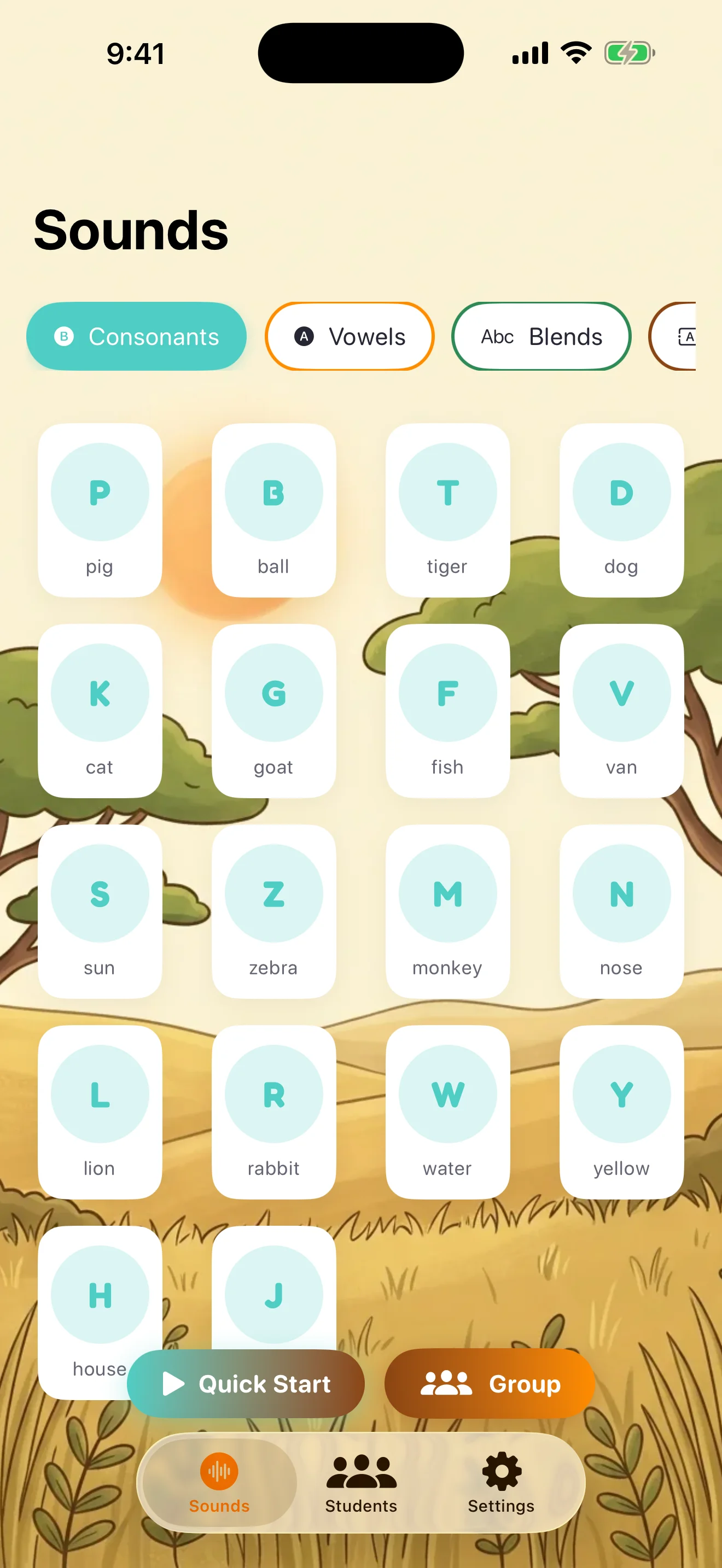
If your child is using Sound Safari at home, the app handles the practice structure automatically — word lists by position, visual feedback on correct productions, and a progress graph that updates in real time so you can see improvement week over week without keeping a notebook yourself.
When to see an SLP
Consider scheduling a speech-language evaluation if any of the following is true:
- Your child is 6 years 0 months or older and still substitutes /w/ for /r/ or produces a distorted /r/ that affects how others understand them
- Your child is aware of their /r/ error and avoids words that contain /r/ in conversation
- Teachers, coaches, or family members frequently need to ask your child to repeat themselves
- Your child has started refusing to speak up in class or is withdrawing socially
For school-aged children, the school-based SLP evaluation is free under the Individuals with Disabilities Education Act (IDEA). You can request an evaluation in writing at any time, and the district has a specific timeline to complete it. For preschool and private evaluations, cost ranges from roughly $200 to $500 depending on region and scope. Many parents do both — the school evaluation for IEP services and a private evaluation for more intensive one-on-one therapy outside school hours.
Outcomes vary by stimulability, age of initiation, and home support, but the consensus in the field is that /r/ is remediable at any age — teenagers and even adults have successfully corrected /r/ in therapy. Age makes the process longer, not impossible.
Frequently Asked Questions
At what age should my child produce the /r/ sound correctly?
Roughly 50% of children produce /r/ correctly by age 4 years, and 90% by age 6 years (Crowe & McLeod 2020). If a child is past 6;0 (six years) and still substitutes /w/ for /r/ or produces a distorted /r/, the sound is typically considered an IEP-candidate. Before 6;0, /r/ errors are usually developmentally typical.
Is /r/ difficult or easy to fix in speech therapy?
/r/ is widely considered the most challenging articulation sound to remediate. It has 21 distinct allophones, two different correct tongue placements (retroflex and bunched), and both consonantal and vocalic contexts. Most kids need 6 months to 2 years of focused therapy to master /r/ across all contexts, depending on stimulability, age of initiation, and home support.
What’s the difference between retroflex and bunched /r/?
Retroflex /r/ is produced with the tongue tip curled up and back toward (but not touching) the alveolar ridge. Bunched /r/ is produced with the tongue tip down or neutral and the tongue body bunched up toward the back of the mouth. Both produce a correct-sounding /r/ — research shows neither is superior. Clinicians try both and use whichever placement the child can produce most easily.
Should I correct my child’s /r/ at home?
Model the correct production rather than demanding correction. During spontaneous speech, if your child says “wabbit,” you can respond “yes, a rabbit!” with a slight emphasis on the /r/. Save explicit correction for scheduled 5–10 minute practice sessions. Constant correction during conversation increases frustration and can decrease the child’s willingness to talk.
How long does /r/ therapy usually take?
For a child who is stimulable for /r/ (can produce it with cues), therapy typically takes 6–12 months from isolation to conversational generalization. For children who are not stimulable or who start therapy later (age 9+), the timeline can extend to 2–3 years. Progress is usually non-linear — isolation and word level come faster than sentence and conversation.
What are minimal pairs and how do they help with /r/?
Minimal pairs are two words that differ by only one sound, like red and wed (R vs W) or right and light (R vs L). Practicing these contrasts trains the child’s auditory discrimination and helps them notice the meaningful difference between their error production and the correct /r/. Minimal pairs are one of the most evidence-supported strategies in articulation therapy.
Can apps help with /r/ practice?
Yes. Practice apps can handle the three most time-consuming parts of /r/ homework: generating word lists by position (initial, medial, final), scoring productions during practice, and tracking progress over time. Sound Safari’s /r/ module includes 30+ initial, 29 medial, and 30+ final position words plus minimal-pair practice for R vs W and R vs L contrasts.
My teenager still has /r/ trouble. Is it too late?
No. /r/ remediation is possible at any age, though therapy typically takes longer for older children and adults because the habitual motor pattern is more entrenched. Teens often do well in therapy when they are self-motivated — motivation is a bigger predictor of outcome than age past the developmental window. An evaluation with an SLP will establish stimulability and set realistic expectations.
Closing
/R/ is the hardest articulation sound in American English, but it is absolutely remediable — at any age, with the right approach. The therapy progression is well-established: stimulability, isolation, syllable, word, sentence, conversation. The two correct tongue placements (retroflex and bunched) give clinicians flexibility. Minimal pairs and targeted word lists by position turn practice from an abstract drill into something a child can actually feel the difference of. And short, frequent home practice compounds faster than occasional long sessions.
If you want structured /r/ practice with word lists, minimal pairs, and progress tracking that an SLP can review, Sound Safari was built for exactly that workflow. For the /s/ sound equivalent — frontal vs lateral lisps, minimal pairs, and the lisp-type-specific therapy approach — see our /s/ sound therapy guide. For the /l/ sound — light vs dark /l/, /l/-blends, and liquid gliding — see our /l/ sound therapy guide. Fourteen-day free trial, cancel anytime through Apple.