 Sound Safari
Free · No email needed
Free speech therapy resources
Printables, word lists and guides for speech-language pathologists, teachers and parents working on speech sounds. Everything here is free to download, print and share with the families and students you work with: no email address, no sign-up.
Free printables
One-page PDFs sized for US Letter. Print them for your desk, your speech room or the fridge.
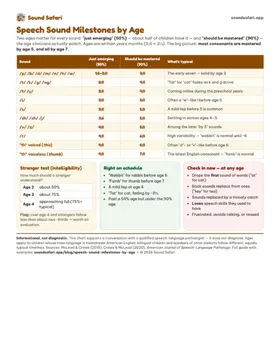
Speech Sound Development Chart
When each consonant is just emerging (50% of children) and when it should be mastered (90%), ages 2 to 7, plus how much a stranger should understand at each age.
PDF · 1 page · free, no email
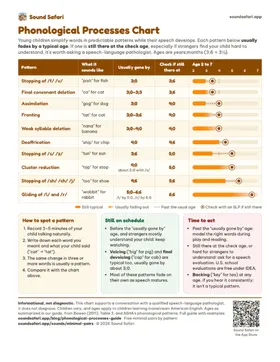
Phonological Processes Chart
Ten common speech patterns, from fronting to gliding, with an example of each, the age each one usually fades, and the age to check with an SLP if one is still there.
PDF · 1 page · free, no email
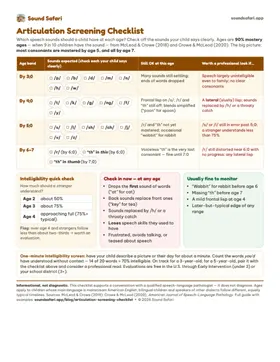
Articulation Screening Checklist
The sounds most children say clearly by 3, 4, 5 and 6–7, what is still fine at each age, when a professional look is worth it, and a quick intelligibility check.
PDF · 1 page · free, no email
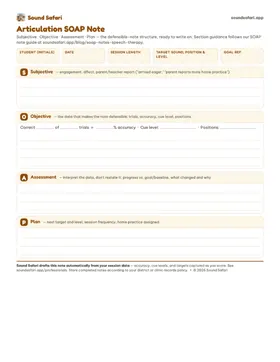
Articulation SOAP Note Template
A blank one-page SOAP note with prompts for each section: engagement, the trial and accuracy data, what changed and why, and the plan for next session.
PDF · 1 page · free, no email
Word lists and minimal pairs
The same words children practice in the Sound Safari app, sorted by where the sound falls in the word. Every word comes with a picture, and on each sound page you can tap a word to hear it.





Guides for SLPs
Goal writing, documentation and data, with copy-ready examples.
- Speech Therapy IEP Goals: 50+ Examples by Sound 50+ copy-paste SMART articulation IEP goals by sound, with baselines, accuracy targets, and timeframes. Based on Crowe & McLeod (2020) U.S. norms.
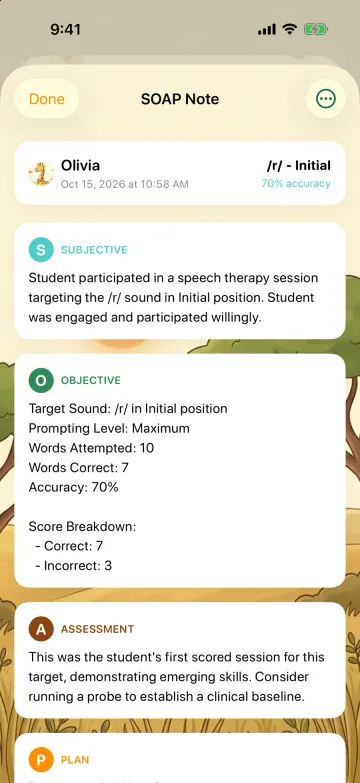
- SOAP Notes for Speech Therapy: Examples by Section Write defensible articulation SOAP notes fast: a section-by-section guide with copy-ready /r/, /s/, /th/, and cluster examples, plus a cue-level table.
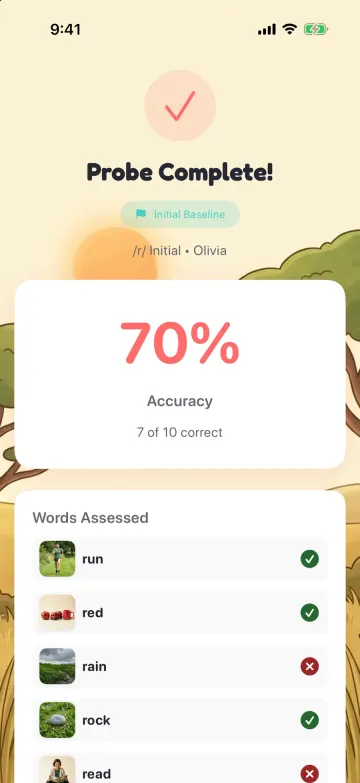
- Speech Therapy Data Collection: An SLP's Guide Speech therapy data collection, explained for SLPs: trial-by-trial vs probe, accuracy math, cue levels, turning tallies into IEP updates and SOAP notes.
- Baseline Data in Articulation Therapy: SLP Guide Collect, calculate, and use a clean articulation baseline for defensible IEP goals: probe vs first-session data, accuracy %, target-setting, progress.
- Cueing & Prompt Hierarchy in Speech Therapy How to scaffold and fade cues in articulation therapy: the prompt hierarchy, when to fade, and how to record prompt level as growing independence.
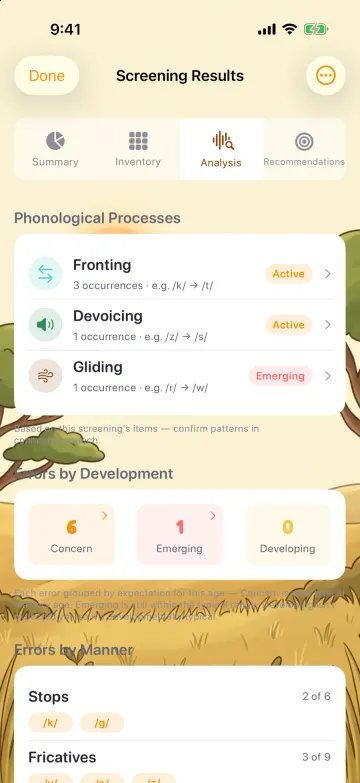
- Phonological Processes: Chart, Ages & Examples What each phonological process sounds like ('tat' for cat, 'top' for stop), the age it usually fades, and when to check with an SLP. Free printable chart.

Therapy guides, sound by sound
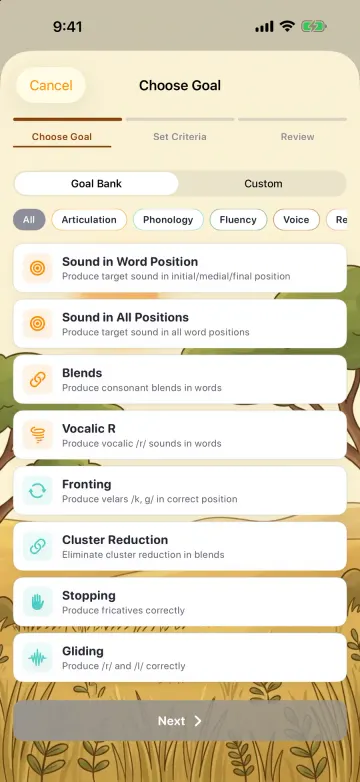
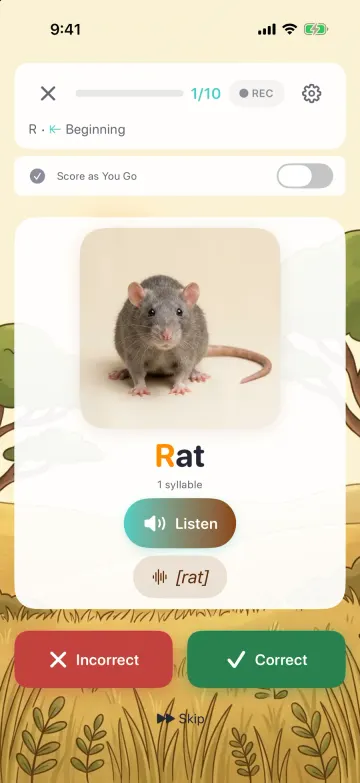
Placement cues, error patterns, word lists, minimal pairs and sample IEP goals for every sound in the library.









Guides for parents
What's typical at each age, what isn't, and what to do next.
- Speech Sound Milestones by Age: A Parent Guide When each speech sound should develop from age 2 to 7, what intelligibility to expect, which errors are normal, and when to consider a speech evaluation.
- When to See a Speech Therapist for Your Child When a speech concern is worth acting on: the signs by age (18 months to 7) and the free US routes — Early Intervention and the school district.
- Articulation Screening Checklist (Free, by Age) A free, age-grouped articulation screening checklist with McLeod & Crowe (2018) mastery ages, intelligibility benchmarks, and a refer-or-monitor guide.
Working with an SLP?
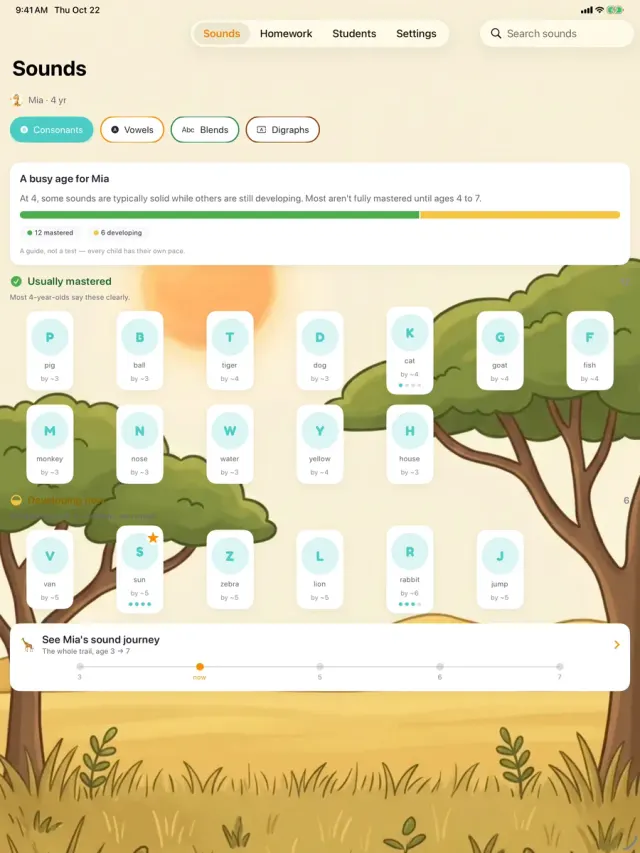
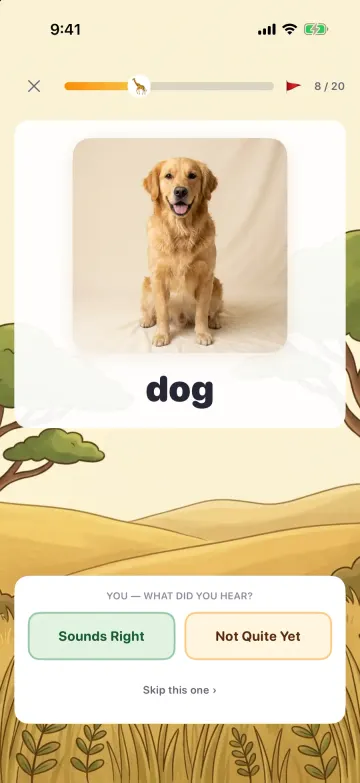
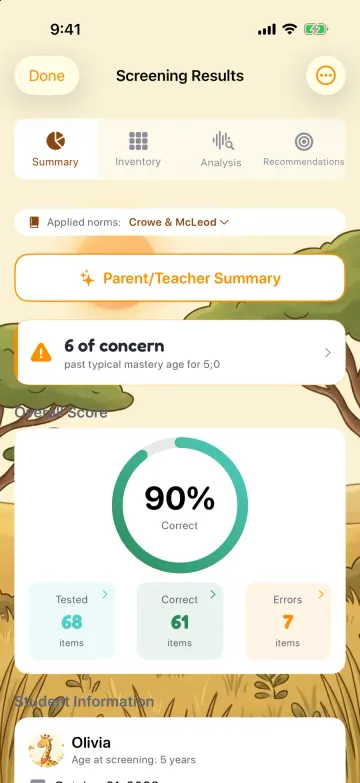
If your child's SLP uses Sound Safari, homework can arrive as a link. It opens in any phone or computer browser, with a picture for each word and your SLP's practice tips. You mark each try, and the results go back to your SLP. You don't need the app or an account. How home practice works
Not sure where your child stands? The Home Sound Check in the app takes about five minutes: your child names pictures, you tap what you hear, and you see which sounds are on track for their age. It's parent-completed, not an evaluation.
Free resources — frequently asked questions
Are these speech therapy resources really free? expand_more
Yes. Every printable, word list and guide on this page is free to view, download and print, with no email address or sign-up. The Sound Safari app is the only paid part, and it starts with a 14-day free trial.
Can I share them with families and students? expand_more
Yes. Print them for the families, students and colleagues you work with. To share online, link to this page or to the resource itself, so people always get the latest version.
Where do the developmental ages come from? expand_more
The sound ages come from McLeod & Crowe (2018) and its U.S. companion, Crowe & McLeod (2020). Each consonant gets two ages: when about half of children say it correctly (50%) and when nine in ten do (90%). The same ages appear on the development chart, the screening checklist and every sound page. The phonological processes chart uses the ages in our processes guide, from Bowen (2011) and ASHA.
